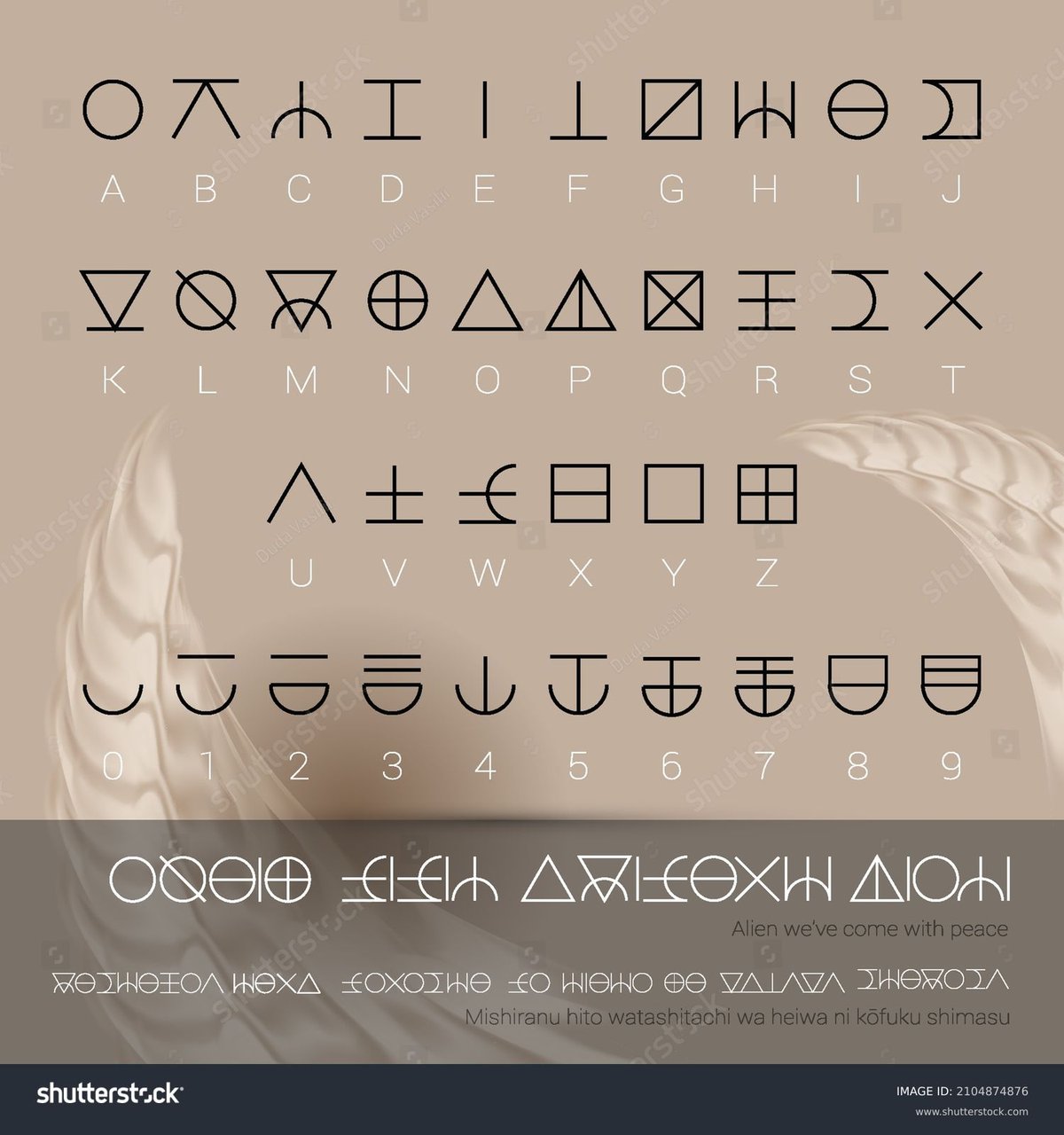
Imagine stepping onto a new world, a place wholly alien, yet utterly believable. What's the first thing that truly clinches that immersion for you? Often, it’s the subtle, intricate details – the way a street sign curls in an unfamiliar script, the ancient runes etched into a monument, or the glyphs on a data pad that hint at a civilization far beyond our understanding. This is the power of Fictional Alien Alphabets & Lore: they're not just decorative flourishes; they are linguistic DNA that breathes life into your universe, making it tangible, ancient, and undeniably real.
Crafting a believable alien alphabet is a masterclass in worldbuilding. It's about designing more than just symbols; it's about encoding a species' history, biology, technology, and culture into every stroke and curve. As a seasoned worldbuilder or storyteller, you know that true authenticity comes from the ground up, and a well-conceived alien script can elevate your narrative from mere fantasy to epic saga.
At a Glance: Key Takeaways for Your World's Language Journey
- Alphabets are Culture: A fictional alphabet isn't just random squiggles; it reflects the alien species' biology, environment, technology, and history.
- Form Follows Function: Consider how the aliens would write (claws, tentacles, light projections) and what they're writing on.
- Beyond Letters: Decide if your system is alphabetic, syllabic, or logographic, and let that decision inform its complexity and appearance.
- Leverage Tools: Modern generators can kickstart your design process, saving time and sparking creativity.
- Integrate Deeply: Don't just design a font; weave its meaning, history, and usage into your world's lore for maximum impact.
- Consistency is Key: Once established, stick to your rules to maintain believability.
Beyond Gibberish: Why Authentic Alien Alphabets Are Non-Negotiable
It's tempting to slap some random symbols onto a prop or screen and call it a day. But to a discerning audience, that often registers as "generic sci-fi filler." A thoughtfully designed alien alphabet, however, does heavy lifting for your story:
- Deepens Immersion: When every visual detail, including text, feels unique and purposeful, your audience is pulled deeper into your world. They're not just reading a story; they're experiencing a culture.
- Enhances Authenticity: A custom script suggests a rich history and a developed civilization, immediately elevating your world beyond a mere backdrop. It signals that you, the creator, have thought through the minutiae.
- Unlocks Storytelling Opportunities: An alien alphabet can serve as a plot device – an ancient language to decipher, a coded message to transmit, or even a system of magic. Its very existence can hint at societal structures, past conflicts, or religious beliefs.
- Adds Visual Distinctiveness: In a crowded genre, unique visual elements help your world stand out. An iconic alien script can become as recognizable as a starship design or a species' silhouette.
Ultimately, designing believable fictional alien alphabets and lore is about respecting your audience and the integrity of your creation. It's about showing, not just telling, the depth of your imagined universe.
The DNA of an Alien Alphabet: Core Considerations
Before you even think about penning your first glyph, you need to dig into the fundamental characteristics of the species and the world that birthed it.
Culture & History First: What Shapes Their Words?
Every human writing system carries echoes of its origins – from the pictograms of ancient Egypt to the flowing scripts of East Asia. The same must be true for your alien creation.
- Biology: Do your aliens have hands, claws, tentacles, or communicate through light? Their physical interaction with the world profoundly influences how they might write. A species with multiple prehensile limbs might produce complex, multi-directional scripts, while a gelatinous creature might "write" by altering its pigmentation or leaving chemical trails.
- Environment: Does their planet have harsh winds that erode surfaces, or is it perpetually submerged in water? Environmental factors dictate the durability and common forms of their writing medium. Perhaps they carve into stone, etch onto metallic tablets, or project holographic text.
- Technology Level: Are they a pre-industrial society, limited to chisels and ink? Or do they possess advanced bio-printers, energy projectors, or even telepathic data transfer? Their tech shapes their tools, which in turn shapes their script.
- Societal Structure & Beliefs: A militaristic empire might favor sharp, angular, hierarchical scripts, while a peaceful, communal society might develop flowing, interconnected forms. Sacred texts might employ ornate, complex characters, while everyday communication uses simpler, streamlined versions.
Form Follows Function (and Biology): How Do They Write?
Consider the practicalities. If your aliens use a specific tool to write, the script should reflect that. For instance:
- Claw-wielding species: Might produce deep, gouged marks, or broad, sweeping strokes.
- Energy beings: Their "writing" might be light patterns, shifting electromagnetic fields, or resonant frequencies, potentially manifesting as complex geometric patterns or pulsating symbols.
- Aquatic creatures: Could use bioluminescent patterns, currents to etch into soft sediment, or chemical secretions to leave messages on the ocean floor.
These questions aren't just details; they are design constraints that will make your alphabet feel truly alien and believable, rather than just another human font with pointy bits.
Linguistic Roots: What Does it Sound Like?
While an alphabet is visual, it's intrinsically linked to spoken language. Even if you're not fully developing a conlang (constructed language), considering some basic linguistic principles will inform your script.
- Phonetics: What sounds do your aliens make? Do they have many harsh consonants, soft vowels, clicks, or hums? An alphabet for a species that communicates largely through guttural growls might look starkly different from one that uses intricate whistles and trills.
- Grammar & Syntax: How do their sentences typically flow? Do they read left-to-right, right-to-left, top-to-bottom, or even in spirals? This influences character arrangement and the overall "feel" of a written passage.
- Writing System Type:
- Logographic: Each symbol represents a whole word or concept (like ancient Egyptian hieroglyphs or some Chinese characters). This often leads to complex, intricate symbols.
- Syllabary: Each symbol represents a syllable (like Japanese hiragana/katakana). These tend to have a moderate number of distinct characters.
- Alphabetic: Each symbol represents a single sound (like the Latin alphabet). These typically have a smaller number of characters and can appear simpler, though complexity can be added with diacritics.
- Abjad: Like an alphabet but only consonants are written (Hebrew, Arabic). Vowels are inferred or indicated by diacritics.
- Abugida: Characters represent consonants with an inherent vowel, which can be modified by diacritics (Devanagari, Thai).
Choosing a system early on gives you a framework for how many characters you'll need and how they'll relate to each other.
Crafting Your Own Alien Script: A Practical Framework
Now that we've laid the groundwork, let's get practical. How do you actually go from abstract concepts to concrete symbols?
Step 1: Define Your World's Style & Civilization
This is where you consolidate all the considerations from the previous section. Before designing, articulate:
- The Alien Species: What do they look like? How do they move? What are their dominant senses?
- Their Culture: Are they ancient and spiritual, or futuristic and technological? Are they nomadic or settled? What are their core values?
- Their Environment: Is it organic, metallic, crystalline, aquatic?
- Their Mediums: What do they write on? What do they write with?
For instance, an ancient, subterranean insectoid race might have a script carved into stone, featuring segmented, angular characters that mimic their chitinous exoskeletons and the patterns of their tunnels. Contrast this with a space-faring, energy-based entity whose "writing" might be shimmering, fractal light patterns on starship interfaces.
Step 2: Sketching the Glyphs: From Concept to Character
Once you have a clear vision, start experimenting.
- Basic Shapes: Begin with a set of fundamental shapes (circles, squares, triangles, lines, curves, dots) that resonate with your chosen aesthetic.
- Combine and Evolve: Combine these basic shapes in various ways. Think about how many strokes each character takes. Are they simple and efficient, or complex and ritualistic?
- Legibility vs. Alienness: This is a crucial balance. You want it to look alien, but if your audience (or in-world characters) needs to decipher it, it can't be completely random. Often, familiarity in stroke direction or recurring elements helps.
- Directionality: Decide how the script flows. Left-to-right, right-to-left, top-to-bottom, vertical columns, or even spiraling?
- Diacritics & Ligatures: Consider adding small marks (diacritics) above, below, or through characters to modify their sound or meaning. Ligatures are characters that merge when placed next to each other, adding fluidity.
Don't be afraid to create many iterations. The first few attempts will likely be too human-like or too chaotic. The magic happens in the refinement.
Step 3: The Digital Edge: Leveraging Fictional Alphabet Generators
Let's be honest: creating an entire alphabet from scratch, ensuring consistency, and making it look professional is a lot of work. This is where modern tools can be an absolute game-changer. Platforms like a fictional alphabet generator are designed to kickstart your creative process and handle much of the heavy lifting.
How to Use a Generator Effectively:
- Input Your World's Style: The best generators allow you to input parameters based on your world's aesthetic, historical influences, culture, technology, and history. This aligns perfectly with our Step 1. You might choose "organic," "geometric," "ancient," "futuristic," or specify influences like "aquatic" or "crystalline."
- Generate and Review Options: Use the generator to create several alphabet options. Don't settle for the first one. Experiment with different settings. Look for options that resonate with your pre-defined aesthetic and linguistic needs. Perhaps you need a script that looks rough-hewn for a primitive society, or sleek and minimalist for an advanced one. A good custom alien alphabet generator will provide diverse starting points.
- Customize and Refine: This is crucial. A generator provides a foundation, but you are the architect.
- Adjust Letter Shapes: Tweak individual glyphs to better match your vision. Maybe a certain character needs to be more angular, or another more flowing.
- Match Sounds and Grammar: If you have basic phonetic ideas for your alien language, map the generated characters to those sounds.
- Add Unique Features: Incorporate diacritics, ligatures, or specific cultural symbols that the generator might not automatically produce. This is where you inject true uniqueness.
Benefits of Using an AI-Powered alien text generator: - Enhance Worldbuilding: It provides a concrete, visual element that immediately adds depth and authenticity, making your world more engaging and believable. You’re no longer just describing alien text; you’re showing it.
- Save Time and Effort: Manually designing dozens of consistent characters is time-consuming. An AI-powered generator simplifies custom language creation, allowing you to iterate quickly and focus on broader storytelling. Imagine the hours saved not having to sketch every single letter!
- Inspire Creativity: Sometimes, a visual prompt is all you need. The generator provides a strong starting point, often offering options you might not have conceived on your own, allowing you to focus your creative energy on other aspects of worldbuilding and storytelling. It can even spark new lore ideas just by seeing the script. When you use a tool to create alien text, you open up new avenues for inspiration.
Remember, a generator is a tool, not a replacement for your creative vision. Use it to accelerate your process, but always apply your unique touch to ensure the final product is truly yours.
Common Pitfalls to Avoid When Designing Alien Scripts
Even with the best intentions (and the best tools), it's easy to stumble. Here are some common traps to steer clear of:
- The "Just a Font" Trap: The biggest mistake is creating something that looks merely like a quirky font variation of English, rather than a truly distinct writing system. Avoid simply swapping "A" for a pointy "A" and "B" for a curvy "B." Think conceptually, not just cosmetically.
- Ignoring Context (No "Why"): If your script doesn't have a logical reason for its appearance, it will feel arbitrary. Every aspect of the design – its angles, curves, spacing, and medium – should tie back to the alien's biology, culture, and environment.
- Inconsistency is the Enemy: Once you establish rules for your alphabet (e.g., how characters are formed, how they connect, their size ratios), stick to them. Inconsistency quickly breaks immersion.
- Over-Complexity for Complexity's Sake: While alien scripts should be unique, making them so convoluted that they become unreadable or impossible to implement across various mediums diminishes their utility. There's a fine line between intricate and impractical.
- Lack of Meaning: Each character doesn't necessarily need a deep etymological root, but the overall script should convey something about the culture. Does it look ancient, futuristic, aggressive, peaceful, organic, or mechanical?
Beyond Letters: Integrating Lore and Meaning
A truly great alien alphabet isn't just a collection of symbols; it's a living artifact within your world.
- In-World Usage: How is the script actually used? Is it reserved for sacred texts, government decrees, or everyday street signs and comms? Consider its presence on technology, clothing, architecture, and even tattoos.
- Evolution of the Script: Like human languages, alien scripts can evolve over millennia. Perhaps an ancient, complex form is used for ceremonial purposes, while a simplified, modern version is used daily. Show how the script has adapted to new technologies or cultural shifts.
- Secret Meanings & Hidden Messages: Can certain characters be combined to form a secret code? Are there esoteric meanings embedded within specific glyphs, known only to a select few? This adds layers of mystery and depth.
- Calligraphy & Art: Do your aliens have their own forms of calligraphic art, where the act of writing itself is a valued skill or spiritual practice? This can add a beautiful cultural dimension.
Making Your Alien Script Live: Practical Applications
Once you've designed your alphabet, put it to work!
- Prop Design: Use your alphabet on physical props like data tablets, ancient artifacts, weapon engravings, or space station signage.
- UI Elements: If your story features advanced technology, integrate the script into user interfaces, holograms, and console displays.
- Environmental Storytelling: Etch glyphs into temple walls, scatter scrolls with alien script in forgotten ruins, or have it painted on trade ships.
- Puzzles & Decipherment: Your script can become a central plot point. Characters might need to translate an alien message to avert disaster or unlock a forgotten secret.
- Character Development: An alien scholar might be an expert in ancient scripts, or a warrior might have sacred glyphs tattooed on their body.
Your Next Step in Worldbuilding Excellence
The journey of creating a believable alien world is paved with a thousand details, and your fictional alien alphabets and lore are among the most impactful. They offer a tangible, visual gateway into the heart of an imagined civilization.
Don't let the complexity intimidate you. Start with the core principles, define your world's style, and then embrace the powerful tools available to you. Whether you meticulously hand-draw every character or lean on a well-designed alien text generator to spark your ideas, the goal remains the same: to craft something that feels so authentic, so steeped in its own unique history and culture, that your audience can't help but believe it exists.
Now, go forth and give your aliens a voice – and a written legacy – that truly belongs to them. The universe awaits your indelible mark.